Time for a new Gig Rack

Hi,

I built my current gig rack in late 2017, so it has lasted me well. I am still on the fence, but I I am toying with the idea of going all out and making one last gig rack that will see me through to retirement from live music (whenever that is, but certainly a rack with similar 8 year life span will most likely see me out! :wink: )

The basic principle will be no different - an NUC style PC embedded in the rack, using my GeChic Touch Panel for the display and UI. The rack will house all the ancillaries like USB audio I/F (hopefully also one that does away with separate line mixer), IEM, trusty Nord G2 Engine, MIDI Interface, DMX interface, etc.

And I am planning component purchases for the audio I/F and MIDI I/F such that if I did retire from gigging they would go into my studio to upgrade current devices. So they will not be wasted.

When it comes to the processor front, I am just wondering what people are looking at these days?

I am looking at something like this (from the vendor I bought my current gig PC from).

Seems a reasonable price (will need tailoring from the base spec), and I go from a four physical core machine (8 threads) to 16 cores (22 threads), which is hopefully a boon for running several soft synths in complex songs.

I was also looking at an NUC14SRKU9 machine using the Ultra 9 185H Processor, but there was no difference in core count, the max clock speed looked a little quicker, but the model I was looking at would add ÂŁ1,000 to the cost compared to the ASUS NUC.

When I look my current GIGPC, even on complex songs, it barely breaks above 15% CPU load, but timeload can get a bit uncomfortable on complex songs with 60-70% time load (which is about 20% lighter on my DAWPC). I am running double buffered at 320 samples on my current Focusrite 2nd Gen Scarlett 2i4 I/F

I would have thought the increase in cores is going to be a huge help with time load more than anything, and I am looking at a MOTU interface that runs over Thunderbolt for which both PCs come with at least one port, which hopefully will give me really good latency to help that timeload further, but also gives a lot of flexibility in recording during gigging or doing some other processing of incoming audio if needed

Thoughts?
Hey Derek,

overall, the spec looks pretty good - 16 cores should be perfectly fine; I suspect that a typical Cantabile song won’t always be able to make full use of the number, since a lot of things will need to be processed in sequence, so difficult to parallelize. So single core performance will remain a crucial element of system performance.

The one thing I am wary of is the whole NUC architecture concept - essentially, it builds on laptop technology, including all the power-saving mechanisms involved in maximizing battery life. And these same mechanisms keep us live audio musicians in constant pain - some of them are extremely intrusive and resistant to de-activation…

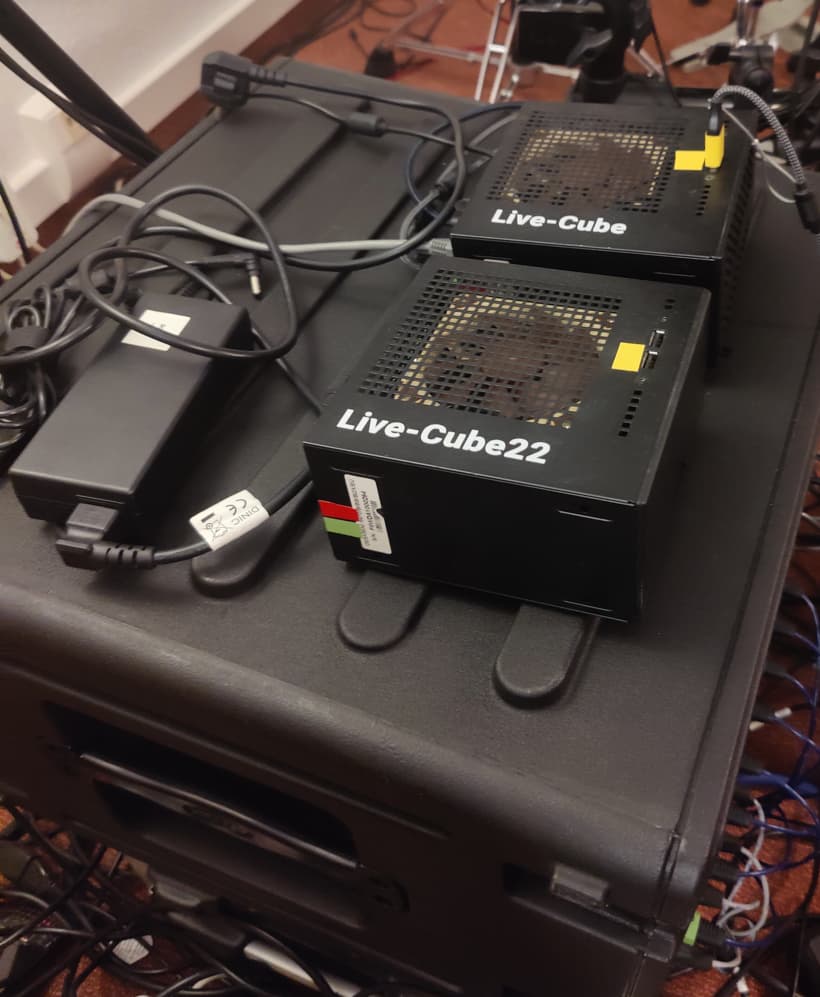
Personally, I prefer small form factor PCs - my current “LiveCubes” have been built on the ASRock DeskMini platform - it allows the use of desktop processors up to 65 W.

Thermal load is overall a key limiting factor for small form factor devices - the more cores you add into the equation, the lower the CPU speed needs to be kept to avoid “meltdowns”, so there’s always a balance to be kept between number of cores and single core performance…

My current live setup typically runs at less than 50% time load, even on my “smaller” i5 6-core DeskMini. And that holds also for fairly big and complex song setups. The power of desktop architecture :wink: …

Just some thoughts - not a definitive answer. YMMV…

4 Likes

Thermal solution

6 Likes

Thanks for your thoughts, @Torsten

I went for my current specific NUC PC on Neil Durant’s recommendation (along with the GeChic Touch Monitor), and it has worked well over the years with no heat issues, so I think a reasonable compromise for something I want to fit in a rack, accepting the constraints you mention. I will be doing some more checks on core usage as part of making my choice.

But I had a quick look at those DeskMinis, but I think I would struggle to efficiently fit them easily inside a rack , which is one of my criteria. Their dimensions are not bad, but exceed the 1U my current NUC PC fits in (It sits on a rack tray along with other things) and the replacement one I am looking at is taller but also keeps within 1U. The DeskMinis are a lot taller and would need 2U, but looks like they would have to be placed on one side, and would that impact airflow, as it looks like one side is “open”, and that way around the sides would be up against the rack tray and the next item in the rack above it.

Out of curiosity, how do you mount/package yours?

TBH, I simply sit them on top of my rack - I carry them to the gig in a camera bag, since I don’t want to subject them to the rack transport… I have three color-coded USB/HDMI connections from my rack to the LiveCube, so connecting is a matter of a minute. And it makes swapping out from main to backup a breeze - unplug 4 cables (Power, USB, HDMI), plug them into the other cube and boot up.

This way, also no issue around airflow…

3 Likes

Thanks for sharing. And those pictures clearly show the grilled panel and large fan, which is not going to be compatible with fitting in a rack which would restrict airflow.

I think I will stick with my approach, and see how it goes, but thanks for your thoughts.

But another out of interest Q: have you ever had to switch to your backup and how often?

I do go through a lot of “what if thinking” to make sure I am as resilient as possible, but at the end of the day I have so many single point failures elsewhere in the rig, I have personally not gone for main and backup computer (so far) as touch wood I cannot the last time I ever had a computer failure, especially with everything being solid state these days.

1 Like

Is the Beelink Mini PC EQR7, AMD Ryzen 7 7735U (16 GB RAM, 500 GB SSD) a good choice? Any other advice about something similar? Many thanks!

TBH, I can’t really comment on AMD Ryzen processors - I stick to what I know, and that is Intel processors…

But regarding the 7735U: this is a notebook processor and will work within a mobile-focused chipset - with all the potentially nasty side-effects of notebook power management. Mind you, it can probably be made to work nicely, but I try to stick to desktop CPUs - typically far easier to get rid of all the power-management hiccups that try to reduce CPU power consumption and can cause complications with audio processing.

Just my 0.02 EUR

Thanks, Torsten. I see your point, but I’d like to use a mini-PC, like your Live-Cube. What could be the best choice in your opinion (no Mac)?

My Live-Cubes are all built around desktop processors (see my post above)

The small form factor limits the maximum thermal load (typically 65 W), which is similar to NUCs, but I find desktop CPUs and motherboards easier to manage.

Hi Carpenzano,

I have an AMD Ryzen 7 5700U (8 real cores at 4.2 GHz) Lenovo laptop. The U is for very low power usage and it fights you all the way to make it perform the way it should. It just doesn’t want to increase the CPU speed. After a ridiculous amount of kernel tweaking, I do have it behaving, but I cannot recommend it for music. It’s great for general purpose with Linux on another partition.

On the other hand, I previously had an MSI laptop with an Intel H series processor 2 generations older that screamed with very little work. Unfortunately I fried it. (fat fingers and a screw driver in the wrong place)

So, if you go with a mobile processor, I recommend an Intel H series processor. BTW, IMHO, the only cores that count for music are the P cores, the rest is marketing noise.

Cheers John

1 Like

The secret to decent audio performance is TDP (thermal design power) - it describes how much heat a CPU can handle. With audio processing, you want the CPU running at full speed all the time, so this creates quite a bit of heat.

A U series AMD or Intel CPU typically is optimized for lower TDP - around 15 W. Stay away from these - they will fight to slow down the CPU whenever they can to avoid “meltdown”.

The higher performance series processors (H and HX series in the Intel world) can cope with more TDP - often 55-65 W. Still, there’s quite a bit of power management to get around.

My typical Live Cube setup is optimized towards 65 W TDP with desktop CPUs, and I can run quite a bit of load on it.

2 Likes

Very clear. Many thanks, Torsten

Many thanks, john. I will avoid the AMD Ryzen 7 5700U

I got 2 Intel Nuc12s a couple years ago, one for primary gig rig and another for backup. I just don’t have the time or inclination or experience to build my own SFF. They have i7 1260p chips which were designed for mobile so theoretically it should be subject to the problems that Torsten mentioned. While Torsten is of course right about thermal design, my real world experience with this particular chip has been quite positive. No dropouts, no issues, running 44.1 at 64. Power management was pretty easy and it doesn’t revert back. Project lasso also helps, I started using that in the last year and I get some improvement especially on my heaviest CPU songs. I love how small and cheap (and lightweight!) the NICs are, with native thunderbolt which was crucial for me since I have a quantum 2626 thunderbolt 3 interface and get extremely low latency with it. I believe Asus took over the NUCs. Another thing to look for is the highest single core speed you can get within your budget. Brad has mentioned that previously… That’s one of the most important things in a new pc. Anyway I’m not pushing NUCs, there are many ways to skin the cat, but for my particular needs it has worked well.
Tom

2 Likes

Agreed. I did eventually go the NUC route (like I had in my original rack) and have had no issues.

My gig rig is documented in my Gig Rack Guide.

I started this thead to get advice, and I eventually went for the ASUS NUC14RVKU7 Core Ultra 7 as it seemed to have the right cost/performance ratio. I fitted it out with 64GB of RAM and 2TB SSD as you can never have too much of RAM and disk space, and resource needs only ever increase over time!

I use Process Lasso to optimise performance and give priority to Cantabile.

2 Likes

Many thanks, twaw

Hi, Derek. Many thanks

1 Like

I just broke down and upgraded by Gigging Surface Pro 7 to the 12th gen Intel. I bought the OLED with the i7 Core which cranks out 16 cores. Price was hard to justify but I rationalized that things weren’t getting any better for a while.

I cannot believe how quickly Cantabile loads up. I just to use a lot of Exclusions in my Set Lists. But this machine can manages it easily. It’s better performance than my older Desktop now.

Great discussion. I’m working on switching from bass to keys for the alt-rock band I’m in. I was shopping used Surface Pro 8’s with the i7-1185G7 which are selling on ebay for around $400 with 16 GB ram and 512GB storage. I use an external monitor so have decided to go the NUC12-WSK-1260p on the above recommendation. I just made a $299 offer for one with 8GB - will spend another $100 to increase to 16GB

EDIT - seller accepted above offer - should receive unit by early next week.

1 Like