I was wondering if anyone here is using Cantabile as an active crossover for a multi-way system. I realize that’s not the main purpose of the software, but given how straightforward my live setup is compared to what Cantabile can offer, I thought I’d give it a shot.
I created a new audio output without assigning any physical channels from my audio interface and checked the “Enable Loopback” box. That gave me the corresponding audio input as well (both marked as loopback).
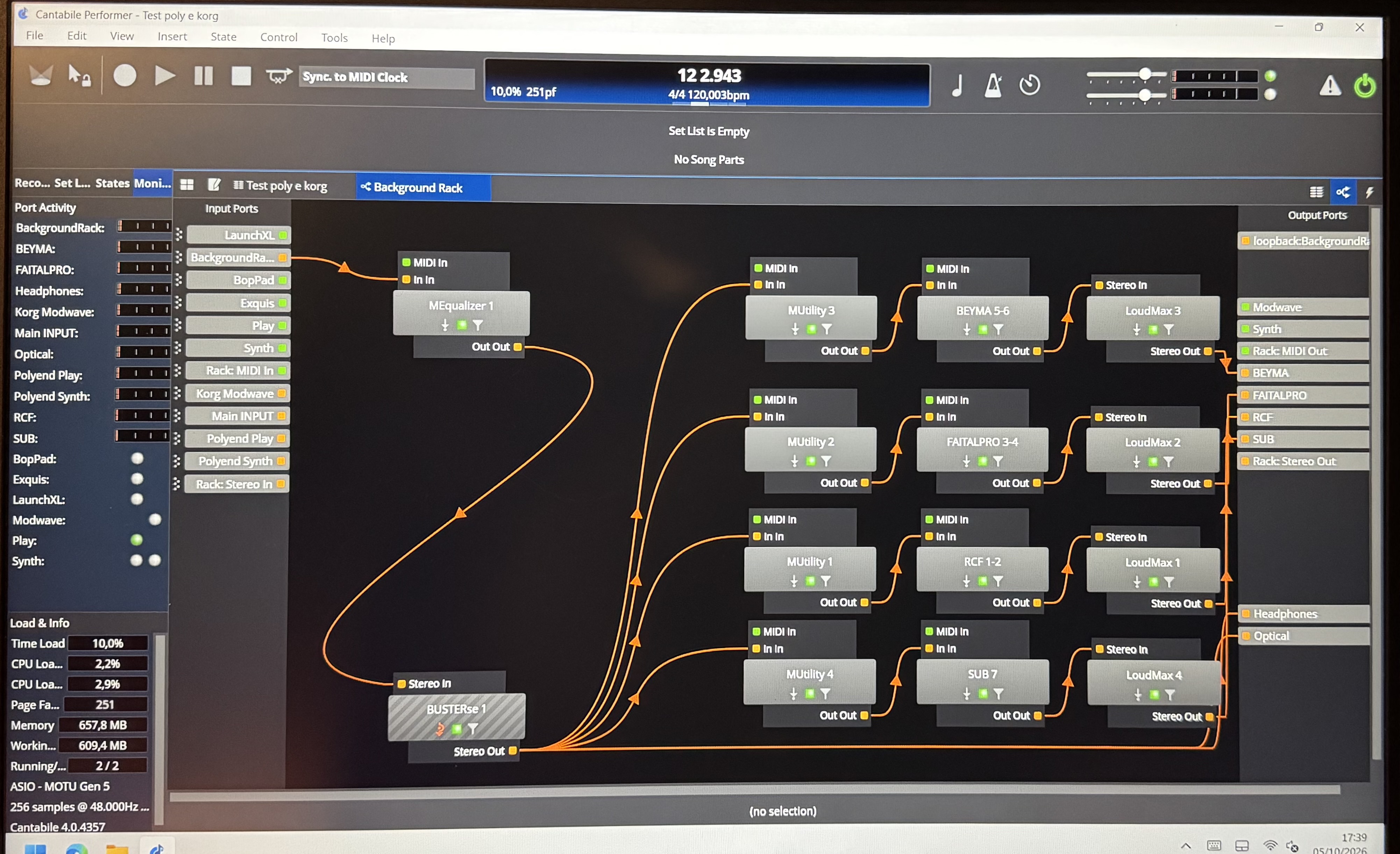
My songs (or rather, my single song containing a ton of—maybe too many—states) route to the “Loopback Out” on the right column. In the Background Rack, I took the “Loopback In” from the left column and split it across four minimum-phase stereo EQs (with oversampling turned off). Each EQ is chained to its own brickwall limiter (four in total). The stereo output from each limiter goes to its respective output channel pair created for my interface—routing out to the power amps for highs, mids, lows, and the sub.
How do you guys handle active crossovers? Have you ever tried a setup like this in Cantabile?
I’ve only been using Cantabile Performer for a couple of months, so I’m not even sure if my routing approach is ideal or if there’s a better/dedicated feature for this.
Anyway, if you’ve had the patience to read all the way through, you’re already my hero!
In my memory you are the first user to do this and post about it. That said it is an interesting approach to interfacing with your speaker systems. To paraphrase Brad the developer , I can’t believe some of the stuff you guys come up with using the Cantabile host. There are plans to add a global output rack which would eliminate the loopback to the background rack. If you have or get the current performer version you can place the filters in a linked rack which you load in each song and also avoid the loopback audio. Personally for my live work I use the passive crossover on my subs and run 2 way mono.
You know, I’m not aware of a crossover plug-in, but it’s worth a search.
Maybe there’s a multi band EQ with an output for each band that would do the job?
Simplest might be running an HPF, LPF, and BPF in parallel and running each virtual output to its own physical output.
Digital phase matching is, relatively speaking, fairly recent. I wonder if there’s a plug-in version of one of those digital speaker processors that automatically deals with phase adjustment and room EQ.
Thanks everyone for all the valuable advice! I’m still trying to wrap my head around how this wonderful software works. You can do so much—almost too much!
For now, I’m keeping the crossover in the Background Rack while using a “mega song” (think Brad Pitt’s megapint) with lots of saved states, rather than creating multiple separate songs. My genre is cyberpunk/synthwave, which means it usually comes down to the same 6 or 7 VST instruments; simply changing states is more than enough without having to create a new song and reload presets. Everything is mainly driven by an external hardware sequencer, plus a few MPE and non-MPE controllers for live tweaking. The sequencer controls a few hardware synths as well.
Back to the crossover: as you can see in the (blurry) photo, all the audio generated by the VSTs and hardware synths routes into the L/R Loopback channels and lands in the Background Rack. Right at the start, there’s an EQ for the house curve to do some quick venue room correction, followed by a bus compressor. From there, the signal splits into the different frequency bands. They are time-aligned first, then filtered with LR24 crossovers, followed by a brickwall limiter, and finally each band goes out to its dedicated power amp.
The gain staging was set up in voltage mode by measuring the outputs using True RMS voltage.
The plugins I’m using are shown in the photo. They’re all free (or almost free) and help preserve the audio interface’s amazing dynamic range. A dedicated hardware unit with the same feature set would cost way more and wouldn’t be nearly as versatile or high-performing.
The speaker setup itself is a hybrid between Hi-Fi and PA. The mid-high section uses an asymmetrical open baffle, the mid-low section is bass reflex, and then there’s the subwoofer (also bass reflex). Months of design and testing for the hardware side… but setting up the crossover in Cantabile? Just a few hours! That alone is priceless.